Showing posts with label general relativity. Show all posts

Friday, 26 April 2024

Basic understanding of a metric tensor:
Disassemble the concept of a distance over Riemannian Manifolds

Preamble 

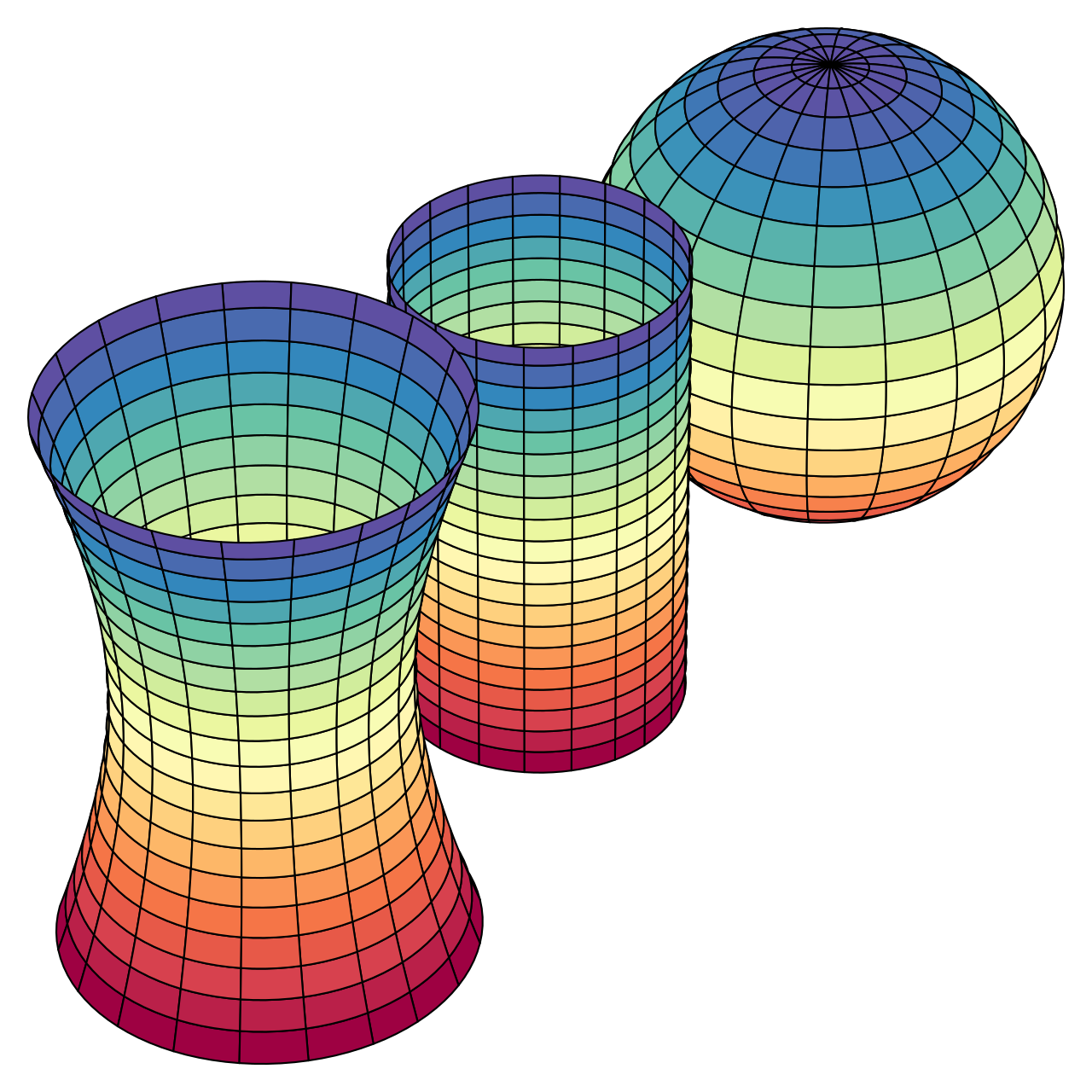
Gaussian Curvature (Wikipedia)
One of the core concepts in Physics is so called metric tensor. This object encodes any kind of geometry. Combined genius of Gauß,  Riemann and their contemporaries lead to such a great idea, probably one of the achievements of human quantitative enlightenment. However, due to notational aspects and lack of obvious pedagogical introduction, making object elusive mathematically. Einstein's notation made this more accessible but still, it requires more explicit explanation.  In this post we disassemble the definition of a distance over any geometry with an alternate notation. 

Disassemble distance over a Riemannian Manifolds

The most general definition of a distance between two infinitesimal points on any geometry, or a fancy word for it, is a Riemannian Manifolds, is defined with the following definitions. Manifold is actually a sub-set of any geometry we are concerned with and Riemannian implies a generalisation.

Definition 1: (Points on a Manifold) Any two points are defined in general coordinates $X$ and $Y$,  They are defined as row and column vectors respectively. In infinitesimal  components. $X = [dx_{1}, dx_{2}, ..., dx_{n}]$ and $Y= [dx_{1}, dx_{2}, ..., dx_{m}]^{T}$. 

Geometric description between two points are defined as tensor product, $\otimes$, that is to say we form a grid, on the geometry. 

Definition 2: (A infinitesimal grid) A grid on a geometry formed by pairing up each point's components, i.e., a tensor product. This would be a matrix $P^{mn}$, (as in points), with the first row $(dx_{1} dx_{1},.....,dx_{1} dx_{n})$ and the last row $(dx_{m} dx_{1},.....,dx_{m} dx_{n})$.

Note that grid here is used as a pedagogical tool, points are actually leaves on the continuous manifold. Now, we want to compute the distance between grid-points, $dS^{n}$, then metric tensor come to a rescue

Definition 3: (Metric tensor) A metric tensor $G^{nm}$ describes a geometry of the manifold that connects the infinitesimal grid to distance, such that $dS^{n}=G^{nm} P^{mn}$.

Note that, these definition can be extended to higher-dimensions, as in coordinates are not 1D anymore. We omit the square-root on the distance, as that''s also a specific to L2 distance.  Here, we can think of $dS^{n}$ a distance vector, and $G^{nm}$ and $P^{mn}$ are the matrices. 

Exercise: Euclidian Metric

A familiar geometry, metric for Euclidian space, reads diagonal elements of all 1 and rest of the elements zero. How the above definitions holds, left as an exercise. 

Conclusion 

We have discuss that a metric tensor, contrary to its name, it isn't a metric per se but an object that describes a geometry, having magic ability to connecting grids to distances. 

Further reading

There are a lot of excellent books out there but a classic Spivak's differential geometry is recommended. 

Please cite as follows:

 @misc{suezen24bumt, 
     title = {Basic understanding of a metric tensor: Disassemble the concept of a distance over Riemannian Manifolds}, 
     howpublished = {\url{https://science-memo.blogspot.com/2024/04/metric-tensor-basic.html}, 
     author = {Mehmet Süzen},
     year = {2024}
}  

Saturday, 18 February 2023

Insights into Bekenstein entropy with an intuitive mathematical definitions:
A look into Thermodynamics of Black-holes

Jacob Bekenstein
(Wikipedia)
Preamble

Thermodynamics of black holes has appeared as one of the most interesting areas of research in theoretical physics [Wald1994], specially after LIGO's massive success. The striking results of Jacob Bekenstein  [Bekenstein1973] in proposing a formulation of entropy for a black hole was on of the most striking turning point in building explanations for the thermodynamics of gravitational systems. Bekenstein entropy is defined to be so-called a phenomenological relationship and surprisingly easy to understand concept using basic dimensionality analysis. In this post, we will show how to understand the entropy of a black hole just using basic dimensionality analysis, fundamental physics constants and basic definition of entropy. 

Dimensions and scales

Dimensionality analysis appears in many different areas of physics and engineering, from fluid dynamics to relativity. The starting point is to understand the concept of dimensions. Every quantity we measure in real life has a dimension. It means a quantity $\mathscr{Q}$  we obtain from a measurement $\mathscr{M}$ has a numeric value $v$ and associated unit $u$. $\mathscr{Q}=\langle  v, u \rangle$ given $\mathscr{M}$. There are 3 distinct fundamental unit types length (L),  time (T) and mass (M).

Intuitive Bekenstein entropy (BE) for a black hole : Informal mathematical definition

Black holes are astronomical objects that are not directly observable due to their mass condensed in a small area. The primary object we will use is something called Planck length $L_{p}$ and it implies physically possible smallest patch of the space-time, this is associated with the state of the black holes on their horizon. We won't define the Planck length here in detail but with the knowledge of fundamental physics constants and dimensional analysis we mentioned, one can get a constant value for this length. 

Definition: Finite entropy $S_{f}$ of an object is associated with the number of states $\Omega$ a system can attain.

If we combine this definition for a black hole entropy : 

Definition Finite entropy of a black-hole $S_{f}^{BH}$ is  associated with the number of its states $\Omega$, number of elements on it's surface area of $A$. The elements are discretised with  small patches $a_{p}=L_{p}^{2}$. Then intuitively,  $\Omega$ yields to $A$ divided by $a_{p}$.
  
Bekenstein entropy is not thermodynamic entropy alone and family of Bekenstein entropies

The unit analysis tells us that $A$ has a dimension of length square.  We intentionally omit any equality in the above definition upon $S_{f}^{BH}$ because, in practice Bekenstein Entropy is not thermodynamic entropy alone. The formulation usually presented as BE in general uses equality for the above approach. However this is not strictly thermodynamical alone, that's why we specify definitions as finite entropy and only express the relationship as association. Similarly any other constants as it can yield to different Bekenstein entropies such as introduction of new constants would yield to family of Bekenstein entropies.

Why surface area defines states of a black-hole?

This is an amazing question and Bekenstein's main contribution is to associate this to number of states of a black-hole on event horizon, i.e., point of of no return layer whereby ordinary matter can't return. The justification is that all other properties of black hole defines this surface. Here is the intuitive definition of states of black-hole.

Definition A surface area $\mathscr{A}$ is formed by the set of physical properties forming an ensembles. such as charge density, angular momentum. These ensembles indirectly samples thermodynamics ensembles. 

Even though intuition is there, this question might still be an open question further.

Conclusion

We provided the primary idea that Bekenstein tried to convey in his 1973 paper intuitively. However,  we identify its thermodynamic limit is an open research area. Thermodynamic limit implies that taking infinite limit of both area and the discretised areas, even though it sounds that the values might converge to infinity, simultaneous limit would converge to a finite value for a physical matter. 

Primary Papers
Primary Book

Please cite as follows:

 @misc{suezen23ibe, 
     title = {Insights into Bekenstein entropy with an intuitive mathematical definitions}, 
     howpublished = {\url{https://science-memo.blogspot.com/2023/02/bekenstein-entropy.html}, 
     author = {Mehmet Süzen},
     year = {2023}
  }

Postscript A: 

Information can’t be destroyed


Proposals of that information is destroyed out of thin air is a red flag for any physical theory: this includes theories on evaporating black holes. Bekenstein’s insight in this direction that surface area is associated with entropy. The black-holes’   information in this context is quite different than the Shannon’s entropy. An evaporating black-hole, the area approaching to zero is not the same as information going to zero, surface area is a function of  physical properties of the stellar object that bound  by conservation laws in their interaction with their surrounding. Hence, the information is preserved even if area goes  to zero.


Postscript B: 

What is Holographic principle? its origins from Bekenstein Entropy perspective

The word embedding applies in this context as well. Embedding implies some sort of  dimensionality projection. A projection to lower dimensional space, or on the other end,  to the higher dimensional space. Holography is no different. Imagine taking 2D snap shots of rotating 3D objects, generating this in reverse is the end effect of holographic  reconstruction. N-dimension to (N-1) projection. This is the bases of holographic principle: entropy of black-holes doesn’t appear as all states of its constituted matter,  as normally should have for ordinary matter, it manifest as N-1 projection on it’s surface. This kind of holographic entropy is first noted by Bekenstein; whereby he assigned the event-horizon area as a representation of the states of the black-hole volume. This projection to (N-1)-dimension is improved upon Bekenstein’s approach to generalised situations in explaining how universe might be  a hologram entirely by Gerard 't Hooft and Leonard Susskind. Holographic principle, probably one of the most important development in theoretical physics in recent times.


Monday, 2 January 2017

Testing emergent gravity: Gravitational Lensing to atom interferometer

Paranal Telescopes in Chile. (ESO/H.H. Heyer)
In this post, I would like to briefly discuss emergent gravity, an idea, that gravity itself is an artefact of more fundamental description, such as entropy. Despite the fact that we have an experimental evidence of gravitational waves, thus gravity really exist and physically detectable: The recent results of Laser Interferometer Gravitational-Wave Observatory (LIGO) programme in detecting gravitation waves was a landmark experimental evidence supporting Einstein's General Relativity theory.

Emergent Gravity: Verlinde's thesis

Eric Verlinde has proposed a controversial hypothesis in 2010 that gravity is originated from an entropic force [here]. He has shown that both Newtonian and Einstein's gravitational equations are artefacts of entropic force and in 2016 he proposed a similar approach in explaining galactic motions without the need of using dark matter [here].

Testing Emergent Gravity: Gravitational Lensing

Margot M. Brouwer and her co-workers have published a work [here], using weak gravitational lensing data from ESO telescopes. This was the first evidence for Verlinde's theory which attracted a lot of media attention because of implications in our understanding of the nature of gravity.

Testing Entropic Gravity Directly: Atom Interferometer

Despite this initial test of emergent gravity, there is still a lack of direct experimental evidence for Verlinde's initial hypothesis that force laws are artefacts of entropic force. Recently another approach is proposed to test this entropic force argument, [here], using mater-wave interferometry via utilising part of Newton-Schroedinger. The core idea is there is a direct relationship between the gravitational constant G and the atomic system's quantum state. If this is experimentally feasible, maybe with next generation atom interferometer systems, this could be a direct test for Verlinde's entropic force argument.


(c) Copyright 2008-2024 Mehmet Suzen (suzen at acm dot org)

Creative Commons License
This work is licensed under a Creative Commons Attribution 4.0 International License.