Showing posts with label interpretable machine learning. Show all posts

Sunday, 16 November 2025

Why the simplest explanation is always the best


Preamble

The simplest explanation is always the best among the explanations that are representative.  It is called the principle of parsimony,  Occam's razor. It is the bedrock of scientific enlightenment. There is a recent development that people start to do a category error to discard this principle based on the following setting that lead to misunderstanding: if we say that the simplest model that can explain the data in one representation but another representation requires a more complex model, then we are choosing more complex model. This is obviously wrongThe simplest explanation is to be chosen from the models that captures the complexity on the given representations, not the simplest over both representations. Filter explanations first based on representations then selection follows. Here we shown the core idea via an illustrative example. 

Figure: Circle has a zero Pearson
correlation. (Wikipedia)

Revisiting Occam’s Razor: A case of correlation and geometry


In order to understand this category error, we will work on a concrete example. Let's say we have a data, which is a circular shape $\mathscr{D}(x, y)$, as in figure. We have 3 models: 

$$\mathscr{M}_{1} : y = a x + b $$
$$\mathscr{M}_{2} : y = \sqrt{1-x^{2}} $$
$$\mathscr{M}_{3} : y ~ NN(x)  $$

And $\mathscr{U}$ a utility function, Pearson correlation $C(x, y)$.  We consider performance measure in ranking for the utility and a measure of representation. $\mathscr{M}_{3}$ is a neural network with a lot of parameters.

There is no error in choosing $\mathscr{M}_{1}$ based on the similar correlations these models produce. Principle of parsimony is not violated at all.  This is correct if we are only considering numerical representation. Pearson correlation as a utility works well for purely numerical representation. What about geometric representation? Then we need to change our utility function (representation measure or performance function). 

Let's say if we use curvature as a utility, $\kappa(x,y)$, in this case $\mathscr{M}_{1}$ fails to capture curvature and its is filtered out before Occam's razor can be applied. Then we left with  $\mathscr{M}_{2}$ and $\mathscr{M}_{3}$ . 

Correlation and geometric explanations are two different things. Two vastly different geometries can produce the same correlations.  A model can be quite good in explaining correlation but fails to capture geometric complexity. In this setting, it does not mean that Occam's razor is wrong. We need to apply Occam's razor across representations: numeric, geometric, algebraic, or symbolic, depending on the purpose. Always keep in mind the purpose or utility of model when invoking Occam's razor. Simplest explanation over the required representations that are relevant are the best. 

On the utility, performance and representations measure

Performance function, representation measure and utility functions can be different in real life, here for illustration purposes we consider them interchangeably. 

Conclusion

Nature minimises cost over complexity but under utility constraints. Minimal cost without satisfying utility or representation measure won't be chosen despite being the simplest. We need to filter first based on utility or representation measure before applying Occam's razor. The simplest explanation is always the best among the explanations that are representative. 


 Cite as 

 @misc{suzen25occam, 
     title = { Why the simplest explanation is always the best}, 
     howpublished = {\url{https://science-memo.blogspot.com/2025/11/simplest-explanation-always-best.html}}, 
     author = {Mehmet Süzen},
     year = {2025}
}  


Saturday, 1 April 2023

Resolution of misconception of overfitting: Differentiating learning curves from Occam curves

Preamble 

Occam (Wikipedia)
A misconception that overfitted model can be identified with the  amount of generalisation gap between model's training and test sets over its learning curves is still out there. Even in some prominent online lectures and blog posts, this misconception is now repeated without critical look. In general, this practice unfortunately diffuse into some academic papers and industrial,  practitioners attribute poor generalisation to overfitting. We have provided a resolution of this via a new conceptual identification of complexity plots, so called Occam's curves differentiating from a learning curve. An accessible mathematical definitions here will clarify the resolution of the confusion.   

Learning Curve Setting: Generalisation Gap 

Learning curves explain how a given algorithm's generalisation improves over time or experience, originating from Ebbinghaus's work on human memory.  We use inductive bias to express a model, as model can manifest itself in different forms from differential equations to deep learning.

Definition: Given inductive bias $\mathscr{M}$ formed by $n$ datasets with monotonically increasing sizes  $\mathbb{T} = \{|\mathbb{T}_{0}| > |\mathbb{T}_{1}| > ...> |\mathbb{T}_{n}| \}$. A learning curve $\mathscr{L}$ for $\mathscr{M}$ is expressed by the performance measure of the model over datasets,  $\mathbb{p} = \{ p_{0},  p_{1}, ... p_{n} \}$, hence $\mathscr{L}$ is a curve on the plane of $(\mathbb{T}, p)$.  

By this definition, we deduce that $\mathscr{M}$ learns if $\mathscr{L}$ increases monotonically. 

A generalisation gap is defined as follows. 

Definition: Generalisation gap for inductive bias $\mathscr{M}$ is the difference between its' learning curve $\mathscr{L}$ and the learning curve of the unseen datasets, i.e., so-called training, $\mathscr{L}^{train}$. The difference can be simple difference, or a measure differentiating the gap.

We conjecture the following. 

Conjecture: Generalisation gap can't identify if $\mathscr{M}$ is an overfitted model. Overfitting is about Occam's razor, and requires a pairwise comparison between two inductive biases of different complexities.

As conjecture suggests that generalisation gap is not about overfitting, despite the common misconception. Then, why the misconception? The misconception lies on the confusion of how to produce the curve that we could judge overfitting. 

Occam Curves: Overfitting Gap [Occam's Gap] 

In the case of generating Occam curves, a complexity measure  $\mathscr{C}$  over different inductive biases $\mathscr{M_{i}}$ plays a role. Then the definition reads. 

Definition: Given $m$ inductive bias $\mathscr{M_{i}}$ formed by $n$ datasets with monotonically increasing sizes  $\mathbb{T} = \{|\mathbb{T}_{0}| > |\mathbb{T}_{1}| > ...> |\mathbb{T}_{n}| \}$. An Occam curve $\mathscr{O}$ for a given $\mathscr{M}$ is expressed by the performance measure of the model over complexity-dataset size points  $\mathbb{F} = [(|\mathbb{T}_{0}|, \mathscr{C}),  (|\mathbb{T}_{1}| , \mathscr{C}), ...,  (|\mathbb{T}_{n}| , \mathscr{C}) ] $; Performance of a given inductive bias reads $\mathbb{p} = \{ p_{0},  p_{1}, ... p_{n} \}$, hence Occam curve, $\mathscr{O}$ is a curve on the plane of $(\mathbb{F}, p)$.  
 
Given definition, producing Occam curves are more complicated than simply plotting test and train curves over batches. The ordering in $\mathbb{F}$ forms what is so-called goodness of rank.

Summary and take home

Resolution of misconception of overfitting lies in producing Occam curves to judge the bias-variance tradeoff, not the learning curves of a single model. 

Further reading & notes

  • Further posts and a glossary : The concept of overgeneralisation and goodness of rank.
  • Double decent phenomenon, it uses Occam's curves, not learning curves.
  • We use dataset size as an interpretation of increasing experience, there could be other ways of expressing a gained experience, but we take the most obvious evidence.
Please cite as follows:

 @misc{suezen23rmo, 
     title = {Resolution of misconception of overfitting: Differentiating learning curves from Occam curves}, 
     author = {Mehmet Süzen},
     year = {2023}
}  

Postscript notes

Take home messages

Understanding Generalisation Gap and Occam’s gap

Model selection and evaluations are usually confused by novice and as well as experienced data scientists and professionals doing modelling. There are a lot of misconceptions in the literature, but in practice primary take home messages can be summarised as follows:

1. What is a model? A model is an “inductive bias” of the modeller, a selected parametrised functions for example, a neural network architecture choice. Contrary to many, specific parametrisation of a model (deep learning architecture) is not a different model.
2. A model’s test and training performance difference is about generalisation gap. Overfitting and under-fitting is not about generalisation gap.
3. Overfitting or under-fitting is a comparison problem: How a model deviates from a reference model? This is called Occam’s gap or so called model selection error.
4. Occam’s gap generalises Empirical Risk minimisation over a learning curve.  Empirical risk minimisation itself is not about learning.

How and when a model generalises well and generalisation of empirical risk minimisation are currently an open research topics.

Saturday, 28 January 2023

Misconceptions on non-temporal learning: When do machine learning models qualify as prediction systems?

Preamble

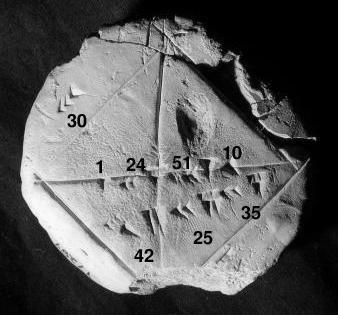
    Babylonian Tablet for 
square root of 2.
 (Wikipedia)
Prediction implies a mechanics, as in knowing a form of a trajectory over time.  Strictly speaking a predictive system implies knowing a solution to the path, set of variable depending on time, time evolution of the system under consideration. Here, we define semi-informally how a prediction system is defined mathematically and show how non-temporal learning can be mapped into a prediction system. 

Temporal learning : Recurrence, trajectory and sequences

A trajectory can be seen as a function of time, identified in recurrence manner. It means $x(t_{i})=f(x_{i-1})$. However, this is one of the possible definitions. The physical equivalent of this appears as a solution to ordinary differential equation, such as the velocity $v(t) = dx(t)/dt$, recurrence on its solution. On the other hand machine learning, an empirical approach is taken and a sequence data such as natural language or a log events occurring in sequence. Any modelling on such data is called temporal learning. This includes classical time-series algorithms, gated units in deep learning and differential equations.

Definition: A prediction system  $\mathscr{F}$ that is build with data $D$ but utilised for a data that is not used in building it $D'$, qualified as such if both $D$ and $D'$ are temporal sets and output of the system is a horizon $\mathbb{H}$, that is a sequence. 

Using non-temporal supervised learning is interpolation or extrapolation

Often practice in industry to turn temporal interactions into flat set of data vectors,  $v_{i}$, $i$ corresponds to a time point or an arbitrary property of the dataset resulting in breaking the temporal associations and causal links.  This could also manifest as set of images with some labels which has no ordering or associational property in the dataset. Even though our system build upon these non-temporal datasets, indeed it constituted a learning systems as interpolation or extrapolation. Their utility in using them for $D'$, strictly speaking does not qualify as prediction systems. 

Mapping with pre-processing

A mapping indeed possible from non-temporal data to a temporal one, if their original form is not in temporal form yet. This is been studied in complexity literature. This requires an algorithm to map flattened data vectors we mentioned into a sequence data. 

Mapping with Causality

A distinct models from causal inference are qualified as predictive systems even if they are trained on non-temporal data, because causality establishes a temporal learning.

Non-temporal modals: Do they still learn?

Even though, we exclude non-temporal model utilisation as non-predictive systems, they still classified as learned models. Because their outputs are generated by a learning procedure. 

Conclusion

Differentiation among temporal and non-temporal learning is provided in associational manner. This results into definition of a prediction system, that excludes non-temporal machine learning models: such as models for unlinked set of vectors, a set of numbers mapped from any data modality. 

Further reading & postscript notes


Tuesday, 20 December 2022

The concept of overgeneralisation and goodness of rank : Overfitting is not about comparing training and test learning curves

Preamble 

    Walt Disney Hall,
Los Angeles  (Wikipedia)


Unfortunately, it is still thought in machine learning classes that overfitting can be detected by comparing training and test learning curves on the single model's performance.  The origins of this misconception is unknown. Looks like an urban legend has been diffused into main practice  and  even in academic works the misconception taken granted. Overfitting's definition appeared to be inherently about comparing complexities of two (or more) models. Models manifest themself as inductive biases modeller or data scientist inform in their tasks. This makes overfitting in reality a Bayesian concept at its core.  It is not about comparing training and test learning curves that if model is following a noise, but pairwise model comparison-testing procedure to select  more plausable belief among our beliefs that has the least information: entities should not be multiplied beyond necessity i.e., Occam's razor. We introduce a new concept in clarifying this practically, goodness of rank to distinguish from well known goodness of fit, and clarify concepts and provide steps to attribute models with overfitted or under-fitted models.

Poorly generalised model : Overgeneralisation or under-generalisation

The practice that is described in machine learning classes, and  practiced in industry that overfitting is about your model following training set closely but fails to generalised in test set. This is not overfitted model but a model that fails to generalise: a phenomena should be called Overgeneralisation (or under-generalisation). 

A procedure to detect overfitted model : Goodness of rank

We have provided complexity based abstract description of model selection procedure, here as complexity ranking: we will repeat this procedure with identification of the overfilled model explicitly.

In the following steps a sketch of an algorithmic recipe for complexity ranking of inductive biases via informal steps, overfitted model identification explicitly:

  1. Define a complexity measure $\mathscr{C}$($\mathscr{M}$) over an inductive bias.
  2. Define a generalisation measure  $\mathscr{G}$($\mathscr{M}$, $\mathscr{D}$) over and inductive bias and dataset.
  3. Select a set of inductive biases, at least-two, $\mathscr{M}_{1}$ and $\mathscr{M}_{2}$.
  4. Produce complexity and generalisation measures on ($\mathscr{M}$, $\mathscr{D}$): Here for two inductive biases: $\mathscr{C}_{1}$, $\mathscr{C}_{2}$,   $\mathscr{G}_{1}$, $\mathscr{G}_{2}$.
  5. Ranking of  $\mathscr{M}_{1}$ and $\mathscr{M}_{2}$:  $argmax \{ \mathscr{G}_{1}, \mathscr{G}_{2}\}$ and $argmin \{ \mathscr{C}_{1}, \mathscr{C}_{2}\}$ 
  6. $\mathscr{M}_{1}$ is an overfitted model compare to $\mathscr{M}_{2}$   if $\mathscr{G}_{1} <= \mathscr{G}_{2}$ and   $\mathscr{C}_{1} \gt \mathscr{C}_{2}$. 
  7. $\mathscr{M}_{2}$ is an overfitted model compare to $\mathscr{M}_{1}$ if $\mathscr{G}_{2} <= \mathscr{G}_{1}$ and   $\mathscr{C}_{2} \gt \mathscr{C}_{1}$.
  8. $\mathscr{M}_{1}$ is an underfitted model compare to $\mathscr{M}_{2}$   if $\mathscr{G}_{1} < \mathscr{G}_{2}$ and   $\mathscr{C}_{1} < \mathscr{C}_{2}$.
  9. $\mathscr{M}_{2}$ is an underfitted model compare to $\mathscr{M}_{1}$   if $\mathscr{G}_{2} < \mathscr{G}_{1}$ and   $\mathscr{C}_{2} < \mathscr{C}_{1}$.
If two model has the same complexity, then much better generalised model should be selected, in this case we can't conclude that either model is overfitted but generalised differently. Remembering that overfitting is about complexity ranking : Goodness of rank.

But overgeneralisation sounded like overfitting, isn't it?

Operationally overgeneralisation and overfitting implies two different things. Overgeneralisation operationally can be detected with a single model. Because, we can measure the generalisation performance of the model alone with data, in statistical literature this is called goodness of fit. Moreover overgeneralisation can also be called under-generalisation, as both implies poor generalisation performance.

However, overfitting implies a model overly performed compare to an other model i.e., model overfits but compare to what? Practically speaking, overgeneralisation can be detected via holdout method, but not overfitting. Overfitting goes beyond goodness of fit to goodness of rank as we provided recipe as pairwise model comparison.

Conclusion

The practice of comparing training and test learning curves for overfitting diffused into machine learning so deeply, the concept is almost always thought a bit in a fuzzy-way, even in distinguished lectures explicitly. Older textbooks and papers correctly identifies overfitting as comparison problem. As a practitioner, if we bear in mind that overfitting is about complexity ranking and it requires more than one model or inductive bias in order to be identified, then we are in better shape in selecting better model. Overfitting can not be detected via data alone on a single model.  


To make things clear, we provide concept definitions.

Generalisation A concept that if model can perform as good as the data it has not seen before, however seen here is a bit vague, it could have seen data points that are close to the data would be better suited in the context of supervised learning as oppose to compositional learning.

Goodness of fit An approach to check if model is generalised well.  

Goodness of rank An approach to check if model is overfitted or under-fitted comparable to other models.

Holdout method A metod to build a model on the portion of available data and measure the goodness of fit on the holdout part of the data, i.e., test and train.

Inductive bias  A set of assumptions data scientist made in building a representation of the real world, this manifest as model and the assumptions that come with a model.

Model  A model is a biased view of the reality from data scientist. Usually appears as a function of observables $X$ and parameters $\Theta$, $f(X, \Theta)$. The different values of $\Theta$ do not constitute a different model.  See also  What is a statistical model?,  Peter McCullagh 

Occam's razor (Principle of parsimony)  A principle that less complex explanation reflects reality better. Entities should not be multiplied beyond necessity.  

Overgeneralisation (Under-generalisation) If we have a good performance on the training set but very bad performance on the test set, model said to overgeneralise or under-generalise; as a result of goodness of fit testing, i.e., comparing learning curves over test and train datasets.

Regularisation An approach to augment model to improve generalisation.

Postscript Notes

Note: Occam’s razor is a ranking problem: Generalisation is not 

The holy grail of machine learning in practice is hold-out methods. We want to make sure that we don’t overgeneralise. However, a misconception has been propagated that overgeneralisation is mistakenly thought of as synonymous with overfitting. Overfitting has a different connotation as ranking different models rather than measuring the generalisation ability of a single model. The generalisation gap between training and test sets is not about Occam’s razor. 

Tuesday, 25 October 2022

Overfitting is about complexity ranking of inductive biases : Algorithmic recipe

Preamble

    Figure: Moon patterns
human brain
 invents. (Wikipedia)
Detecting overfitting is inherently a comparison problem of the complexity of multiple objects, i.e., models or an algorithm capable of making predictions. A model is overfitted (underfitted) if we only compare it to another model. Model selection involves comparing multiple models with different complexities. The summary of this approach with basic mathematical definitions is given here.

Misconceptions: Poor generalisation is not synonymous with overfitting. 

None of these techniques would prevent us from overfitting: Cross-validation, having more data, early stopping, and comparing test-train learning curves are all about generalisation. Their purpose is not to detect overfitting.

We need at least two different models, i.e., two different inductive biases, to judge which model is overfitted. One distinct approach in deep learning, called dropout, prevents overfitting while it alternates between multiple models, i.e., multiple inductive bias. For judgment, dropout implementation has to compare those alternating model test performances during training to judge overfitting. 

What is an inductive bias? 

There are multiple inceptions of inductive bias. Here, we concentrate on a parametrised model, $\mathscr{M}(\theta)$ on a dataset $\mathscr{D}$, the selection of a model type, or modelling approach, usually manifest as a functional form $\mathscr{M}=f(x)$ or as a function approximation, i.e., for example neural network, are all manifestation of inductive biases. Different parameterisation of model learned on the subsets of the dataset are still the same inductive bias.

Complexity ranking of inductive biases: An Algorithmic recipe 

We are sketching out an algorithmic recipe for complexity ranking of inductive biases via informal steps:
  1. Define a complexity measure $\mathscr{C}$($\mathscr{M}$) over an inductive bias.
  2. Define a generalisation measure  $\mathscr{G}$($\mathscr{M}$, $\mathscr{D}$) over and inductive bias and dataset.
  3. Select a set of inductive biases, at least-two, $\mathscr{M}_{1}$ and $\mathscr{M}_{2}$.
  4. Produce complexity and generalisation measures on ($\mathscr{M}$, $\mathscr{D}$): Here for two inductive biases: $\mathscr{C}_{1}$, $\mathscr{C}_{2}$,   $\mathscr{G}_{1}$, $\mathscr{G}_{2}$.
  5. Ranking of  $\mathscr{M}_{1}$ and $\mathscr{M}_{2}$:  $argmax \{ \mathscr{G}_{1}, \mathscr{G}_{2}\}$ and $argmin \{ \mathscr{C}_{1}, \mathscr{C}_{2}\}$
The core concept appears as when generalisations are close enough we pick out the inductive bias that is less complex. 

Conclusion & Outlook

In practice,  probably due to hectic delivery constraints, or mere laziness, we still rely on simple holdout method to build models, only single test and train split, not even learning curves, specially in deep learning models without practicing Occam's razor. A major insight in this direction appears to be that, holdout approach can only help us to detect generalisation, not overfitting. We clarify this via the concept of inductive bias distinguishing that different parametrisation of the same model doesn't change the inductive bias introduced by the modelling choice. 

In fact, due to resource constraints of model life-cycle, i.e., energy consumption and cognitive load of introducing a complex model, practicing proper Occam's razor: complexity ranking of inductive biases, is much more important than ever for sustainable environment and human capital.

Further reading

Some of the posts, reverse chronological order, that this blog have tried to convey what overfitting entails and its general implications. 


Tuesday, 20 September 2022

Building robust AI systems: Is an artificial intelligent agent just a probabilistic boolean function?


Preamble
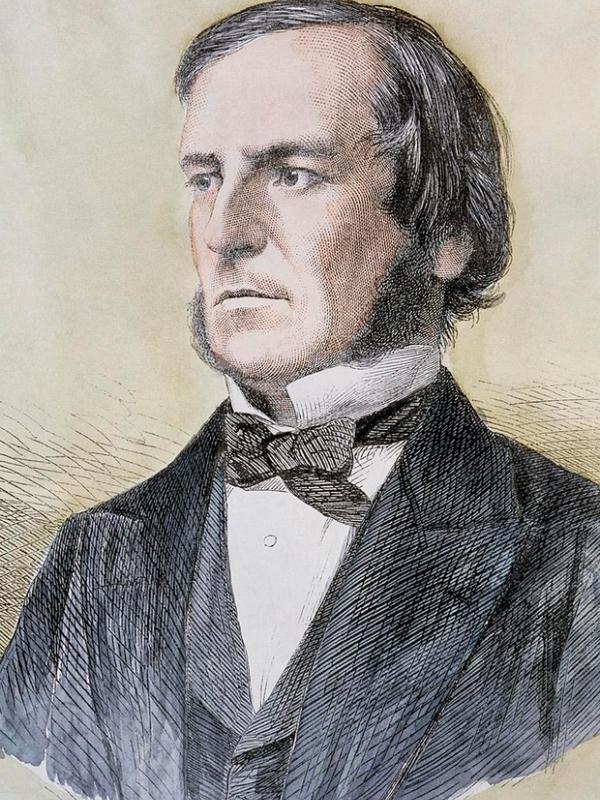
    George Boole (Wikipedia)

Agent, AI agent or an intelligent agent is used often to describe algorithms or AI systems that are released by research teams recently. However, the definition of an intelligent agent (IA) is a bit opaque. Naïvely thinking, it is nothing more than a decision maker that shows some intelligent behaviour. However, making a decision intelligently is hard to quantify computationally, and probably IA for us is something that can be representable as a Turing machine.  Here, we argue that an intelligent agent in the current AI systems should be seen as a function without side effects outputting a boolean output and shouldn't be extrapolated or compare to human level intelligence.  Causal inference capabilities should be seen as a scientific guidance to this function decompositions without side-effects,  i.e., Human in-the loop Probabilistic Boolean Functions (PBFs).

Computational learning theories are based on binary learners

Two of the major  theories of statistical learning PAC and VC dimensions build upon on "binary learning".  

PAC stands for Probably Approximately Correct, It sets basic framework and mathematical building blocks for defining a machine learning problem from complexity theory. Probably correct implies finding a weak learning function given binary instance set $X=\{1,0\}^{n}$. The binary set or its subsets mathematically called concepts and under certain mathematical conditions a system said to be PAC learnable. There are equivalences to VC and other computation learning frameworks. 

Robust AI systems: Deep reinforcement learning and  PAC

Even though the theory of learning on deep (reinforcement) learning is not established and active area of research. There is an intimate connection with composition of concepts, i.e., binary instance subsets as almost all operations within  deep RL can be viewed as probabilistic Boolean functions (PBFs). 

Conclusion 

Current research and practice in robust AI systems could focus on producing learnable probabilistic boolean functions (PBFs) as intelligent agents, rather than being a human level intelligent agents. This modest purpose might bring more practical fruit than long-term aims of replacing human intelligence. Moreover, theory of computation for deep learning and causality could benefit from this approach. 

Further reading


Friday, 11 February 2022

Physics origins of the most important statistical ideas of recent times

Figure: Maxwell's handwritings, 
state diagram (Wikipedia)


Preamble

The modern statistics now move into an emerging field called data science that amalgamate many different fields from high performance computing to control engineering. However, the emergent behaviour from researchers in machine learning and statistics that, sometimes they omit naïvely and probably unknowingly the fact that some of the most important ideas in data sciences are actually originated from Physics discoveries and specifically developed by physicist. In this short exposition we try to review these physics origins on the areas defined by Gelman and Vehtari (doi). Additional section is also added in other possible areas that are currently the focus of active research in data sciences. 

Bootstrapping and simulation based inference : Gibbs's Ensemble theory and Metropolis's simulations


Bootstrapping is a novel idea of estimations with uncertainty with given set of samples. It is mostly popularised by Efron and his contribution is immense, making this tool available to all researchers doing quantitative analysis.  However, the origins of bootstrapping can be traced back to the idea of ensembles in statistical physics, which is introduced by J. Gibbs. The ensembles in physics allow us to do just what bootstrapping helps, estimating a quantity of interest with sub-sampling, in the case of statistical physics this appears as sampling a set of different microstates. Using this idea Metropolis devised a inference in 1953, to compute ensemble averages for liquids using computers.  Note that, usage of Monte Carlo approach for pure mathematical nature, i.e., solving integrals, appear much earlier with von Neumann's efforts.

Causality : Hamiltonian systems to Thermodynamic potentials

Figure: Maxwell 
Relations as causal
diagrams.
Even though the historical roots of causal analysis in early 20th century attributed to Wright 1923 for his definition of path analysis, causality was the core tanents of Newtonian mechanics in distinguishing left and right of the equations of motions in the form of differential equations, and the set of differential equations following that with Hamiltonian Mechanics is actually forms a graph, i.e., relationships between generalised coordinates, momentum and positions. This connection is never acknowledge in early statistical literature, and probably causal constructions from classical physics were not well known in that community or did not find its way to data-driven mechanics. Similarly, causal construction of thermodynamic potentials appear as a directed graph as in, Born wheel. It appears as a mnemonic but it is actually  causally constructed via Legendre Transformations.  Of course, causality, philosophically speaking, is discussed since Ancient Greece but here we restrict the discussion on solely quantitative theories after Newton.

Overparametrised models and regularisation : Poincaré classifications and astrophysical dynamics

The current deep learning systems classified as massively overparametrized systems. However, the lower dimensional understanding of this phenomenon were well studied by Poincare's classification of classical dynamics, namely the measurement problem of having overdetermined system of differential equations, i.e., whereby inverse problems are well known in astrophysics and theoretical mechanics.     

High-performance computing: Big-data to GPUs

Similarly, using supercomputers or as now we call it high-performance computation with big data generating processes were actually can be traced back to Manhattan project and ENIAC that aims solving scattering equations and almost 50 years of development on this direction before 2000s. 

Conclusion

The impressive development of new emergent field of data science as a larger perspective of statistics into computer science have strong origins from core Physics literature and research. These connections are not sufficiently cited or acknowledged. Our aim in this short exposition is to bring these aspects into the attention of data science practitioners and researchers alike.

Further reading
Some of the mentioned works and related reading list, papers or books.

Please cite as follows:

 @misc{suezen22pom, 
     title = { Physics origins of the most important statistical ideas of recent times }, 
     howpublished = {\url{http://science-memo.blogspot.com/2022/02/physics-origins-of-most-important.html}, 
     author = {Mehmet Süzen},
     year = {2022}
  }
Appendix: Pearson correlation and Lattices

Auguste Bravais is famous for his contribution in foundational work on the mathematical theory for crystallography, now seems to be going far beyond periodic solids. Unknown to many, he actually first driven the expression for what we know today as correlation coefficient or  Pearson’s correlation or less commonly Pearson-Galton coefficient. Interestingly, one of the grandfathers of causal analysis Wright is mentioned this in his seminal work of 1921 titled “Correlation and causation” acknowledged Bravais for his 1849 work as the first derivation of correlation.

Appendix: Partition function and set theoretic probability

Long before Kolmogorov set forward his formal foundations of probabilities, Boltzmann, Maxwell and Gibbs build theories of statistical mechanics using probabilistic language and even define settings for set theoretic foundations by introducing ensembles for thermodynamics. For example, partition function (Z) appeared as defining a normalisation factor that summation of densities should yield to 1. Apparently Kolmogorov and contemporaries inspired a lot from physics and mechanics literature.

Appendix: Generative AI

Of course now generative AI took over the hype. Indeed physics of diffusion from Fokker-Planck equation to basic Langevin dynamics is leveraged.  
 
Appendix: Physics is fundamental for the advancement of AI research and practice 


AI as a phenomena appears to be in the domain of core physics. For this reason, studying physics as a (post)-degree or as a self-study modules will give students and practitioners alike a definitive cutting-edge insights.  

  • Statistical models based on correlations originates from physics of periodic solids and astrophysical n-body dynamics.
  • Neural networks originates from the modelling magnetic materials in discrete states and later named as cooperative phenomenon. Their training dynamics closely follows free-energy minimisation.
  • Causality roots in ensemble theory of physical entropy.
  • Almost all sampling based techniques are based on the idea of sampling  physics of energy surfaces, i.e. Potential Energy Surfaces. (PES).
  • Generative AI  originates from physics of diffusion of fluids: classical  Liouville description of the classical mechanics, i.e, phase-space flows and generalised Fokker-Planck dynamics. 
  • Language models based on attention are actually coarse-grained entropy-dynamics
    introduced by Gibbs: ‘Attention Layers’ behaves as coarse-graining procedure, i.e, compressed
    causal graphs mapping.

This is not about building analogies to physics but as foundational topics to AI.


Wednesday, 28 July 2021

Deep Learning in Mind a Gentle Introduction to Spectral Ergodicity

Preamble

    Figure: Monalisa on
Eigenvector grids (Wikipedia)

In the post, A New Matrix Mathematics for Deep Learning : Random Matrix Theory of Deep Learning, we have outlined a new mathematical concepts that are aimed at deep learning but in general belonging to applied mathematics. Here, we dive into one of the concepts,  spectral ergodicity. We aimed at conveying what does it mean and how to compute spectral ergodicity for a set of matrices, i.e., ensemble. We will use a visual aid and verbal descriptions of steps to produce a quantitative measure of spectral ergodicity. 

The idea of spectral ergodicity comes from quantum statistical physics but it is recently revived for deep learning as a new concept in order to accommodate mathematical needs of explaining and understanding the complexity of deep learning architectures.

Understanding Spectral Ergodicity

The concept of ergodicity can get quiet mathematical even for a professional mathematician.  A practical understanding of ergodicity  could lead to the law of large numbers statistically speaking. However, observed ergodicity for ensemble of matrices, i.e. over their eigenvalue spectrum, are not formally defined before in the literature, and only appeared in statistical quantum mechanics in a specialised case.  Here we do a formal definition gently.

The spectral ergodicity of snapshot of values from $M$ matrices, where they are $N \times N$ sizes,  denoted by $\Omega$, can be produce with the following steps:
  1. Compute eigenvalues of $M$ matrices separately.  
  2. Produce equidistance spectra of matrices out of eigenvalues, i.e., histograms with $b_{k}$ bins. Each cell in the Figure corresponds to bin in the spectra of the matrices. 
  3. Compute average values over each bin across  $M$ matrices.
  4. Computing root mean square deviation that went to each bin from $M$ matrices from corresponding ensemble averaged value and average over $M$ and $N$. This will give a distribution, $\Omega=\Omega(b_{k})$, which represents spectral ergodicity value, think as a snapshot value of a dynamical process.
Attentive reader would notice that normally, measures of ergodicity leads to a single value, such as in spin-glasses, but here we obtain ergodicity as a measure distribution. This stems from the fact that our observable is not univariate but it is a multivariate measure over spectra of the matrix, i.e., bins in the histogram of eigenvalues.  

Why spectral ergodicity important for deep learning? 

The reason why this measure is so important lies in dynamics and consistency in measuring observables (no nothing to do with quantum mechanics but time and ensemble averages classically). Normally we can't measure ensemble averages. In experimental conditions the measurement we do is usually a time averaged value. This is exactly what happens when we train deep neural network, i.e, ergodicity of weight matrices. Essentially, spectral ergodicity would capture deep neural network's characteristics.
Outlook

The way we express spectral ergodicity here would only consider all layer having the same size.  One would need a more advanced computation of spectral ergodicity for more realistic architectures, which is called cascading Periodic Spectral Ergodicity measure suitable as a complexity measure for deep learning.  The computation of such measure is more involved and spectral ergodicity we cover here is the first step.

Cite this post with  Deep Learning in Mind Very Gentle Introduction to Spectral Ergodicity, Mehmet Süzen, (2021) https://science-memo.blogspot.com/2021/07/deep-learning-random-matrix-theory-spectral-ergodicity.html 

Sunday, 7 March 2021

Critical look on why deployed machine learning model performance degrade quickly

Illustration of William of Ockham 
(Wikipedia)
One of the major problems in using so called machine learning model, usually a supervised model, in so called deployment, meaning it will serve new data points which were not in the training or test set,  with great astonishment, modellers or data scientist observe that model's performance degrade quickly or it doesn't perform as good as test set performance. We earlier ruled out that underspecification would not be the main cause. Here we proposed that the primary reason of such performance degradation lies on the usage of hold out method in judging generalised performance solely.

Why model test performance does not reflect in deployment? Understanding overfitting

Major contributing factor is due to inaccurate meme of overfitting which actually meant overtraining and connecting overtraining erroneously to generalisation solely.  This was discussed earlier here as understanding overfitting. Overfitting is not about how good  is the function approximation compared to other subsets of the dataset of the same “model” works. Hence, the hold-out method (test/train) of measuring performances  does not  provide sufficient and necessary conditions to judge model’s generalisation ability: with this approach we can not detect overfitting (in Occam’s razor sense) and as well the deployment performance. 

How to mimic deployment performance?

This depends on the use case but the most promising approaches lies in adaptive analysis and detected distribution shifts and build models accordingly. However, the answer to this question is still an open research.

Thursday, 3 December 2020

Resolution of the dilemma in explainable Artificial Intelligence:
Who is going to explain the explainer?

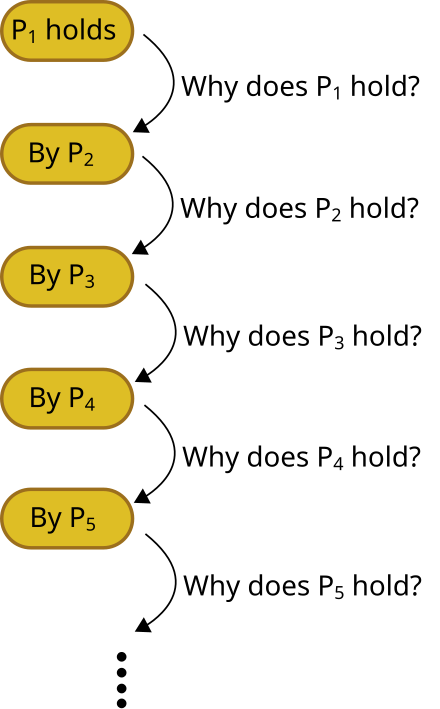
Infinite Regress
 Figure: Infinite
Regress (Wikipedia)
Preamble 

Surge in usage of artificial intelligence (AI) systems, now a standard practice for mid to large scale industries. These systems can not reason by construction and the legal requirements dictates if a machine learning/AI model made a decision, such as granting a loan or not for example, people affected by this decision has right to know the reason. However, it is well known that machine learning models can not reason or provide a reasoning out of box.  Apart from modifying conventional machine learning systems that includes some form of reasoning as a research exercise, practicing or building so called explainable or interpretable machine learning solutions are very popular on top of conventional models. Though there is no accepted definition of what should entail an explanation of the machine learning systems, but in general, this field of study is called explainable  artificial intelligence.

One of the most used or popularised set of techniques essentially build a secondary model on top of the primary model's behaviour and try to come up with a story on how the primary model, AI system, brought up its answers. However, this approach sounds like a good solution at the first glance, it actually trapped us into an infinite regress, a dilemma: Who is going to explain the explainer?

Avoiding 'Who is going to explain the explainer?' dilemma

Resolution of this lies in completely avoiding explainer models or techniques rely on optimisations of a similar sort. We should rely on solely so called counterfactual generators. These generators rely on a repetitive query to the system to generate data on the behaviour of the AI system to answer what if scenarios or a set of what if scenarios, corresponding to a set of reasoning statements. 

What are counterfactual generators?

Figure: Counterfactual generator,
instance based.

These are techniques that can generate a counter factual statement on the predicted machine learning decision. For example for a loan approval model, a counterfactual statement would be 'If applicants income was 10K more a model would have approved the loan". A simplest form of counterfactual generator one can think of is Individual Conditional Expectation (ICE) curves [ Goldstein2013 ], ICE curves shows, what would happen to model decision if one of the feature, such as income, vary over set of values. The idea is simple but it is so powerful that, one can generate dataset for counterfactual reasoning, so the name counterfactual generator. These are classified as model agnostic methods in general [ Du2020, Molnar ] but distinction here we are  trying to make is avoiding building another model to explain the primary model but we solely rely on queries to the model. This rules out LIME, as it relies on building models to explain the model, we question that if linear regression is intrinsically explainable here [Lipton]. One extension to ICE is generating a falling list [ wang14 ] outputs without building models.
 
Outlook

We rule out of using secondary machine learning models or any models, including simple linear regression, in building an explanation for machine learning system. Instead we claim that reasoning can be achieved a simplest level with counterfactual generators based on systems behaviour to different query sets. This seems to be a good direction, as reasoning can be defined as  "algebraically manipulating previously acquired knowledge in order to answer a new question" by Léon Botton [ Botton ] and of course partly inline with Judea Pearl's causal inference revolution, though replacing the machine learning model with the causal model completely would be more causal inference recommendation.

References and further reading

[ Goldstein2013 ] Peeking Inside the Black Box: Visualising Statistical Learning with Plots of Individual Conditional Expectation, Goldstein et. al. arXiv
[ Lipton ] The Mythos of Model Interpretability, Z. Lipton arXiv
[ Molnar ] Interpretable ML book, C. Molnar url
[ Botton ] From machine learning to machine reasoning An essay, Léon Bottou doi
[ Du2020 ] Techniques for Interpretable Machine Learning, Du et. al, doi
[ wang14 ] Falling Rule Lists, Wang-Rudin arXiv


(c) Copyright 2008-2024 Mehmet Suzen (suzen at acm dot org)

Creative Commons License
This work is licensed under a Creative Commons Attribution 4.0 International License.