Friday, 23 April 2021

On the fallacy of replacing physical laws with machine-learned inference systems

Preamble

Progress in machine learning, specifically so-called deep learning, last decade was astonishingly successful in many areas from computer vision to natural language translation reaching automation close to human-level performance in narrow areas, so-called narrow artificial intelligence. At the same time, the scientific and academic communities also joined in applying deep learning in physics and in general physical sciences. If this is used as an assistance to known techniques, it is really good progress, such as drug discovery, accelerating molecular simulations or astrophysical discoveries to understand the universe. However, unfortunately, it is now almost standard claim that one supposedly could replace physical laws with deep learning models: we criticise these claims in general without naming any of our colleagues or works. 

Circular reasoning: Usage of data produced by known physics 

Blind monks examining an elephant
(Wikipedia)

The primary fallacy on papers claiming to be able to produce a learning system that can actually produce physical laws or replace physics with a deep learning system lies in how these systems are trained. Regardless of how good they are in predictions, their primary ability is the product of already known laws. They would only replicate the laws provided within datasets that are generated by physical laws.  

Faulty generalisation: Computational acceleration in narrow application to replacing laws

One of the major faults in concluding that a machine-learned inference system doing better than the physical law is the faulty generalisation of computational acceleration in narrow application areas. This computational acceleration can not be generalised to all parameter space while systems are usually trained in certain restricted parameter space that physical laws generated data, for example solving N-body problems, or dynamics in any scale from action or Lagrangian and generating fundamental particle physics Lagrangians.

Benefits: Causality still requires scientist

The intention of this short article here aimed at showing limitations of using machine-learned inference systems in discovering scientific laws: there are of course benefits of leveraging machine learning and data science techniques in physical sciences, especially accelerating simulations in narrow specialised areas, automating tasks and assisting scientist in cumbersome validations, such as searching and translating in two domains, especially in medicine and astrophysics, for example sorting images of galaxy formations. However, the results would still need a skilled physicist or scientist to really understand and form a judgment for a scientific law or discovery, i.e., establishing causality

Conclusion : No automated physicist or automated scientific discovery

Artificial general intelligence is not founded yet and has not been achieved. It is for the benefit of physical sciences that researchers do not claim that they found a deep learning system that can replace physical laws in supervised or semi-supervised settings rather concentrate on applications that benefit both theoretical and applied advancement in down to earth fashion. Similarly, funding agencies should be more reasonable and avoid funding such claims.

In summary, if datasets are produced by known physical laws or mathematical principles, the new deep learning system only replicates what was already known and it is not new knowledge, regardless of how these systems can predict or behave with new predictions. Caution is advised. We can not yet replace physicists with machine-learned inference systems, actually, not even radiologists are replaced, despite the impressive advancement in computer vision that produces super-human results. 


 @misc{suezen21fallacy, 
     title = {On the fallacy of replacing physical laws with machine-learned inference systems}, 
     howpublished = {\url{http://science-memo.blogspot.com/2021/04/on-fallacy-of-replacing-physical-laws.html}}, 
     author = {Mehmet Süzen},
     year = {2021}
}  


Postscripts

The following interpretations, reformulations are curated after initial post. 


Postscript 1: Regarding Symbolic regression

There are now multiple claims that one could replace physics with symbolic regression. Yes, symbolic regression is quite a powerful method. However, using raw data produced by physical laws, so called simulation data from classical mechanics or modelling experimental data guided by functional forms provided by physics do not imply that one could replace physics or physical laws with machine learned system. We have not achieved Artificial General Intelligence (AGI) and symbolic regression is not AGI. Symbolic regression may not be even useful beyond verification tool for theory and numerical solutions of physical laws.

Postscript 2: Fallacy on the dimensionality reduction and distillation of physical laws with machine learning

There are now multiple claims that one could distill physical dynamical laws with dimensionality reduction. This is indeed a novel approach. However, the core dataset is generated by the coupled set of dynamical equations that is suppose to be reduced with fixed set of initial conditions. This does not imply any kind of distillation of set of original laws, i.e., the procedure can not be qualified as distilling set of equations to less number of equations or variates. It only provides an accelerated deployment of dynamical solvers under very specific conditions. This includes any renormalisation group dynamics.

Postscript 3: A new terms, Scientific Machine Learning Fallacy and s-PINNs.

Usage of symbolic regression with deep learning should be called symbolic physics informed neural networks (s-PINNs. Calling these approaches  “machine scientist”, “automated scientist”, “physics laws generator” are technically  a fallacy, i.e., Scientific Machine Learning Fallacy, primarily caught up in circular reasoning.  

Postscript 4: AutoML is a misnomer : Scientific Machine Learning (SciML) Fallacy 

SciML is immensely promising in providing accelerated deployment of known scientific workflows: specialised areas such as trajectory learning, novel operator solvers, astrophysical image processing, molecular dynamics and computational applied mathematics in general. Unfortunately, some recent papers continue on jumping into claims of automated scientific discovery and replacing known physical laws with supervised learning systems, including new NLP systems.  


The primary fallacy on papers claiming to be able to produce a learning system that can actually produce physical/scientific laws or replace physics/science with a deep learning system lies in how these systems are trained. AutoML in this context actually doesn’t replace scientist but abstract out former workflows into different meta scientific work assisting scientists: hence a misnomer, MetaML is probably more suited terminology. 

Postscript 5: Scientific Machine Learning (SciML) and AI for Science (AI4S): Accelerated meta discovery

SciML is immensely promising in providing accelerated deployment of known scientific workflows: specialised areas such as trajectory learning, novel operator solvers, astrophysical image and cosmological analysis, molecular dynamics and computational applied mathematics in general. Unfortunately, some recent papers or young scientists in their experiences had an impression that SciML is an automated scientific discovery tool that is a replacement of  known physical laws with supervised learning systems, including new LLM systems. The primary fallacy here the resulting learning system  can only produce physical/scientific laws guided by scientists: designing new PINNs and training methodologies for increasing speed of parameter exploration. 

AutoML or SciML in this context actually doesn’t replace scientists but abstract out former workflows into  different meta scientific work assisting scientists. Accelerated meta discovery is probably more suited terminology to avoid such early misunderstandings.



Thursday, 1 April 2021

Shifting Modern Data Science Forward: Dijkstra principle for data science


Prelude
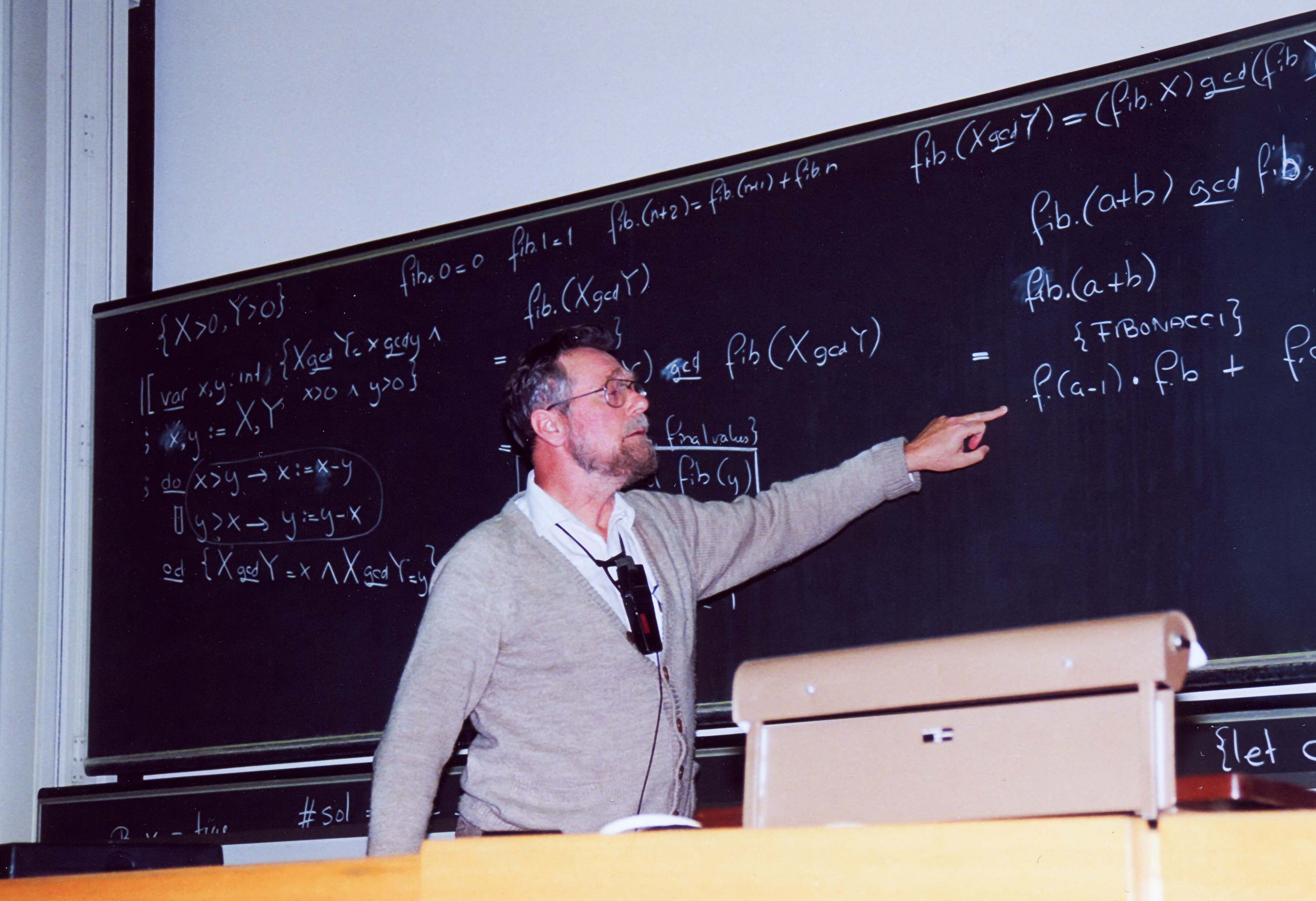
Dijkstra in Zurich, 1984 (Wikipedia)

Edsger Dijkstra was a Dutch theoretical physicist turned computer scientist, and probably one of the most influential earlier pioneers in the field. He had deep insight in what is computer science and well founded notion of how should it be taught in academics. In this post we extrapolate his ideas into data science. We developed something called, Dijkstra principle for data science, that is driven by his ideas on what does computer science entails.

Computer Science and Astronomy 

Astronomy is not about telescopes. Indeed, it is about how universe works and how its constituent parts are interacting. Telescopes, either being optical or radio observations or similar detection techniques are merely tools to practice and do investigation for astronomy. A formed analogy goes into computer science as well, this is the quote from Dijkstra:
Computer science is no more about computers than astronomy is about telescopes.  - Edsger Dijkstra
The idea of Computer Science being not about computer is rather strange in the first instance. However, what Dijkstra had in mind is abstract mechanism and mathematical constructs that one can map real problems and solve it as a computer science problem, such as graph algorithms. Though Computer Science had a lot of subfields but its inception can be considered as rooted in applied mathematics.

Dijkstra principle for data science

By using Dijkstra's approach now we are in position to formulate a principle for data science. 
Data science is no more about data than computer science is about computers. -Dijkstra principle for data science
This sounds absurd. If data science is not about data, then what is it about? Apart from definition of data science as an emergent field, as an amalgamation of multiple fields from statistics to high performance computing,  the idea that data not being the core tenant of data science implies the practice does not aim at data itself rather a higher purpose. Data is used similar to a telescope in astronomy, the purpose is to reveal the empirical truths about representations data conveys. There is no unique ways to achieve this purpose. 

Conclusive Remarks

Dijkstra principle for data science would be very helpful in understanding the data science practice as not data-centric, contrary to mainstream dogma, rather as a science-centric  practice with the data being the primary tool to leverage, using multitude of techniques. Implication is that machine learning is a secondary tool on top of data in practicing data science. This attitude would help causality playing a major role shifting modern data science forward.


Saturday, 20 March 2021

Computable function analogs of natural learning and intelligence may not exist


Optimal learning : Meta-optimization

Many papers directly equate “machine” learning problem, algorithmic learning oppose to human or animal learning, with optimisation problem. Unfortunately, contrary to common belief  machine learning is not an optimisation problem. For example, take optimal learning strategy, a replace learning with optimisation and we end up having and absurd terms of optimal optimisation strategy at one point. 

Turing machine (Wikipedia)
Sound like practiced machine learning is a meta-optimisation problem, rather than a learning as humans do.

Computable functions to learning

Fundamentally, we do not know how human learning can be mapped into an algorithm or if there are computable function analogs of human learning or if human intelligence and its artificial analog can be represented as Turing computable manner.

Sunday, 7 March 2021

Critical look on why deployed machine learning model performance degrade quickly

Illustration of William of Ockham 
(Wikipedia)
One of the major problems in using so called machine learning model, usually a supervised model, in so called deployment, meaning it will serve new data points which were not in the training or test set,  with great astonishment, modellers or data scientist observe that model's performance degrade quickly or it doesn't perform as good as test set performance. We earlier ruled out that underspecification would not be the main cause. Here we proposed that the primary reason of such performance degradation lies on the usage of hold out method in judging generalised performance solely.

Why model test performance does not reflect in deployment? Understanding overfitting

Major contributing factor is due to inaccurate meme of overfitting which actually meant overtraining and connecting overtraining erroneously to generalisation solely.  This was discussed earlier here as understanding overfitting. Overfitting is not about how good  is the function approximation compared to other subsets of the dataset of the same “model” works. Hence, the hold-out method (test/train) of measuring performances  does not  provide sufficient and necessary conditions to judge model’s generalisation ability: with this approach we can not detect overfitting (in Occam’s razor sense) and as well the deployment performance. 

How to mimic deployment performance?

This depends on the use case but the most promising approaches lies in adaptive analysis and detected distribution shifts and build models accordingly. However, the answer to this question is still an open research.
(c) Copyright 2008-2024 Mehmet Suzen (suzen at acm dot org)

Creative Commons License
This work is licensed under a Creative Commons Attribution 4.0 International License.